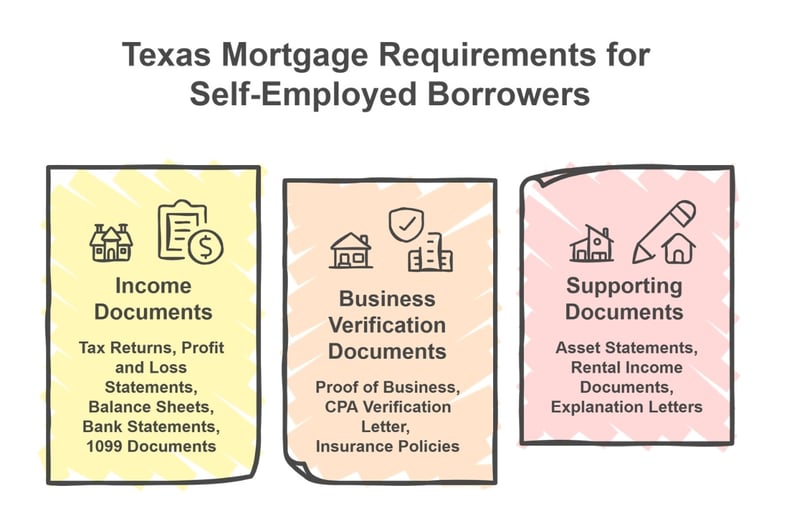
As a self-employed borrower, you must prepare income documents, including personal and business tax returns, bank statements, and profit and loss statements. You may also have to provide business verification documents if applicable.
Keep reading to discover other key requirements when applying for a home loan. Plus, I’ll share a comparison chart by loan type and actionable tips to boost your approval chances.
Let’s dive in!
Self-Employed Mortgage Requirements in Texas
Whether you’re a small business owner, a freelancer, or a contract worker, you could be eligible for home loan programs in Texas if you meet certain requirements.
Lenders will request additional documentation to verify your income if you don’t have traditional documentation like W-2s.
They want to know that you’re financially responsible and you have a consistent, dependable income source to afford monthly mortgage payments.
Lenders will check your credit history, the type of property you’re purchasing, your available funds, and your overall ability to repay the loan. They often request the following documents for self-employed mortgage loans:
Income Documents
- Federal Income Tax Returns – Many lenders require 2 years of complete personal tax returns and 2 years of business returns if you own at least 25% of a business.
- Profit and Loss Statements – Year-to-date P&L statements show revenues, expenses, and net income, demonstrating the current performance of your business.
- Balance Sheets – Some lenders request balance sheets to check your business assets, liabilities, and equity, which gives them insight into your company’s financial health.
- Bank Statements – You may have to provide 12 to 24 months of personal or business bank statements, particularly for bank statement loan programs, to demonstrate income deposits and cash flow patterns, especially if your tax forms show a lower net income because of tax deductions and write-offs. In some cases, borrowers with a consistent deposit history may qualify for a bigger loan amount using bank statements instead of traditional income documentation.
- 1099 Documentation – If you’re a gig or contract worker, some lenders will review your 1099 income in the last 1 to 2 years to determine eligibility.
Business Verification Documents (If Applicable)
- Proof of Business – Submit documents that prove the legitimacy of your business and its ongoing operations for the required period, including state or local business licenses, registration documents, client invoices, and letters from current clients.
- CPA Verification Letter – This helps lenders better understand your business finances and boosts their confidence in your financial capability.
- Insurance Policies – Provide insurance documents demonstrating active business operations.
Supporting Documents
- Asset Statements – Lenders may require these for assets such as investments and retirement accounts to verify your financial reserves and confirm that you have enough funds for homebuying costs.
- Rental Income Documents – Submit leases and other supporting documents for rental properties.
- Explanation Letters – Address potential concerns early on, including irregular business income activity, sizable deposits, or operating expenses, to strengthen your mortgage application and prevent underwriting delays. For example, you’ll have to explain any sudden income drop in recent years and reassure lenders that you can make mortgage payments on time.
Remember, requirements vary by loan program and lender, so be sure to ask your lender about specific documentation and guidelines before submitting your application.
Pro Tip: If you have multiple income sources, like a full-time W-2 job plus a side gig, it’s best to document both to expand your loan options and increase your qualifying amount.
Self-Employed Mortgage Loan Requirement Chart
Check out this chart to know the typical mortgage requirements for self-employed borrowers in Texas:
|
Loan Type
|
Ideal Borrower
|
Down Payment
|
Credit Score
|
DTI
|
Income Docs
|
|
Conventional (Fannie/Freddie)
|
Strong credit profile
|
3% minimum, 20% to avoid private mortgage insurance
|
620+ (740+ for best interest rates)
|
45% to 50%
|
2-year personal and business tax returns, P&Ls
|
|
FHA
|
Lower down payment, lower credit score
|
3.5%+
|
580+
|
43% to 50% with compensating factors
|
2-year tax returns, P&Ls as needed
|
|
VA
|
Eligible veterans
|
0%
|
580 to 620+ depending on the lender
|
41% or higher, depending on residual income
|
2-year personal and business tax returns, P&Ls as needed
|
|
USDA
|
Rural eligible properties, total household income within local limits
|
0%
|
640+
|
41% to 44%
|
2-year personal and business tax returns
|
|
Bank Statement (Non-QM loan)
|
Lower net income due to write-offs and deductions
|
10% to 20%
|
620 to 680+
|
43% to 50%
|
12 to 24 months of bank statements, business proof
|
|
DSCR
|
Self-employed investors/
rental property buyers
|
15% to 25%
|
660 to 700+
|
Varies
|
No personal income documents required, lenders consider the property’s DSCR (rental income is higher than debt payments)
|
Who Qualifies as Self-Employed?
Self-employment covers various employment scenarios. Lenders may consider borrowers as self-employed if they:
- Have sole ownership of a business
- Own 25% or more of a business entity
- Earn income as freelancers, gig workers, or independent contractors receiving 1099 forms
What Lenders Look for When Approving a Self-Employed Mortgage
Unlike salaried employees, self-employed individuals don’t have a guaranteed income. You don’t receive steady, predictable paychecks, and your income may fluctuate from one month to another.
Because of the higher risk, lenders usually apply more stringent documentation standards to evaluate your income and repayment ability. You need to prove that you’re creditworthy and your business generates enough income to support long-term payments.
Lenders often review these factors when evaluating a self-employed borrower:
- 2 years of self-employment history
- Income stability
- The type and structure of your self-employment
- The industry, nature, and location of your business
- Your business’ financial strength and ability to generate sufficient income
By providing clear financial records, you can demonstrate that you have a stable and reliable income source to handle monthly payments despite not having a traditional salary.
How to Improve Your Chances of Qualifying for a Mortgage While Self-Employed
Here are quick tips to improve your loan approval chances:
- Improve your credit score before applying by managing your finances and always paying bills on time.
- Pay down credit cards and reduce debts to improve your DTI.
- Build several months of verified cash reserves to strengthen your application.
- Avoid unexplained large account deposits. If unavoidable, be sure to provide documents proving their source.
- Maintain complete financial records and keep them well-organized.
- Submit all necessary documents promptly and respond quickly to any requests by the lender to avoid delays.
- Increase your down payment to reduce lender risk and possibly increase the loan amount.
Choose a Trusted U.S. Lender Experienced in Self-Employed Mortgages
As a self-employed borrower, you need to work with a dependable lender who understands the unique situation of business owners and independent contractors.
Get pre-approved before searching for your dream home. With pre-approval, you clarify your borrowing capacity and streamline the mortgage application process.
Our experienced loan officers at Texas United Mortgage will help you understand loan requirements and provide personalized support throughout your homebuying journey. We will accurately assess your true qualifying income.
Reach out to us now to start your pre-approval process!









Comments