For self-employed borrowers without traditional income documentation, some Texas mortgage lenders accept bank statement loans as a flexible financing option.
Read on to understand how bank statement loans work, which lenders offer them, and what lenders look for when reviewing loan applications.
What Is a Bank Statement Loan?
A bank statement loan is a non-qualified mortgage (non-QM) loan program that uses a borrower’s personal or business bank statements instead of tax returns, W-2s, or pay stubs. However, this loan type may require a larger-than-usual down payment and stronger liquid assets than traditional mortgage programs.
Non-QM loans don’t follow the qualified mortgage guidelines set by the Consumer Financial Protection Bureau (CFPB) for verifying a borrower’s ability to repay the loan. Mortgage lenders may use alternative income documentation to evaluate an applicant’s income.
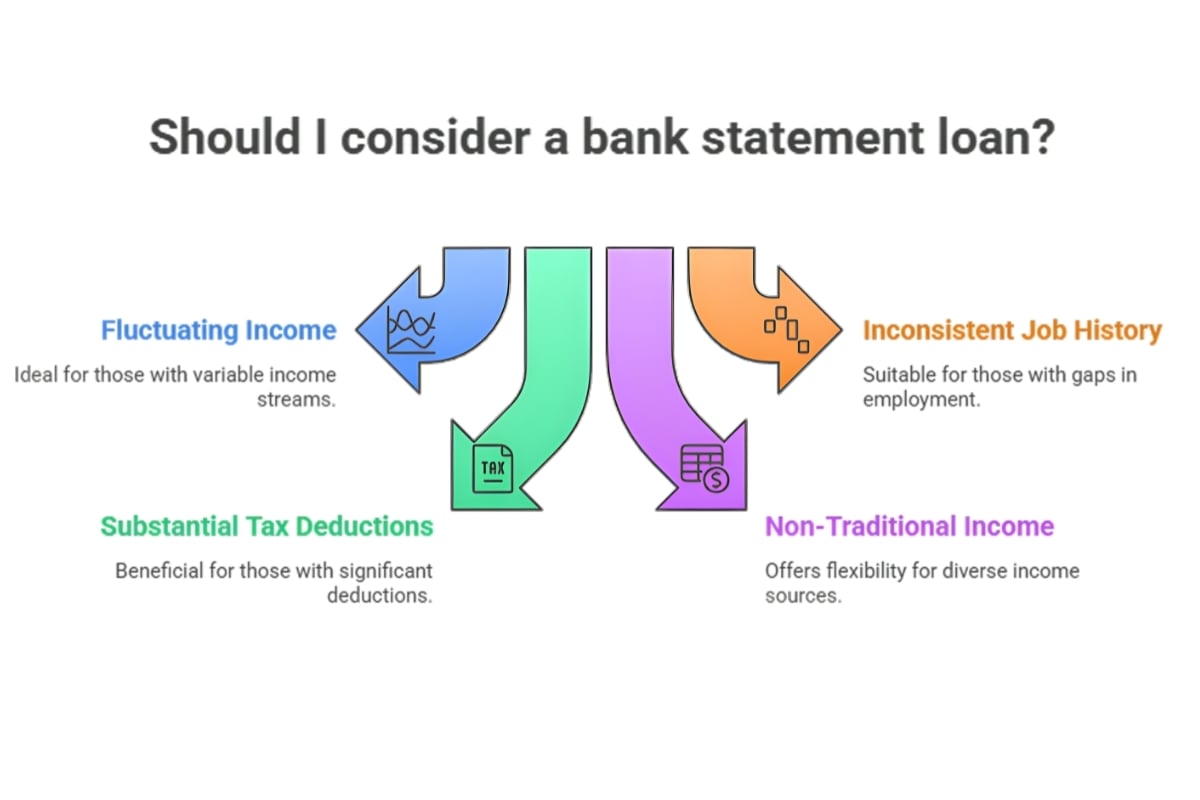
Bank statement loans provide flexibility for individuals who don’t earn income as traditional employees. These borrowers often have:
- Fluctuating income
- Inconsistent job history
- Substantial tax deductions
- Nontraditional income streams
Here are the main pros and cons of these loans:
|
Pros
|
Cons
|
|
More flexible qualification for self-employed borrowers
|
Larger down payment and higher interest rates
|
|
Alternative income documentation through bank statements
|
Higher closing costs and fees
|
|
Applicable to primary residences, second homes, and investment properties
|
Limited availability
|
Texas Mortgage Lenders That Offer Bank Statement Loans
Not all lenders provide these loans. In Texas, some lenders may offer bank statement loans and other alternative loan programs with varying terms, pricing, and requirements.
Bank statement loans are commonly available through:
- Non-bank mortgage lenders offering non-QM loan programs and alternative income verification
- Portfolio lenders providing in-house loans with their own income documentation guidelines
- Several credit unions and regional banks that offer flexible underwriting for trusted borrowers with strong financial profiles
Follow these quick tips to choose the best mortgage lender for your financial needs:
🠊 Choose a local lender, as they understand Texas home prices, property taxes, and state-specific lending rules that national lenders may overlook. Local lenders like Texas United Mortgage offer insider knowledge and personalized guidance for homebuyers in the Lone Star State.
🠊 Make sure the lender has positive reviews, ratings, and reputation. They should work closely with you to find the best loan option for your needs. Don’t hesitate to ask about fees, costs, interest rates, and any other part of the loan process.
🠊 Confirm proper licensing and registration, ensuring the lender and loan officer meet state and federal requirements, to avoid compliance issues and delays.
🠊 Avoid sketchy online lenders and too-good-to-be-true offers. Go with reputable mortgage lenders with a proven track record.
With over 30 years of experience, our mortgage experts at Texas United Mortgage have helped many self-employed borrowers secure a home loan. Our loan officers will help you compare your loan options and provide a tailored solution that fits your goals, timeline, and budget.
Who Are Bank Statement Loans For?
Self-employed individuals, business owners, freelancers, consultants, seasonal workers, and full-time real estate investors are good candidates for bank statement loans.
These loans can be a good match if your financial profile doesn’t meet traditional lending requirements, especially if:
- You don’t have traditional documentation for income verification but have verifiable, sustainable income to get a mortgage.
- Large tax write-offs don’t fully reveal your income, making it hard to prove your ability to repay.
- You have a substantial cash flow but complex tax returns.
Here are a few scenario examples:
Scenario 1: A self-employed business owner in Texas earns $250,000 in gross income, but their tax returns report only $150,000 after a $100,000 equipment deduction. While a traditional loan would use the lower taxable income, a bank statement loan averages the monthly deposits shown on the bank statements, revealing the business owner's true cash flow and income capacity.
Scenario 2: A freelancer receives direct deposits and transfers from multiple clients instead of a payroll. While their income fluctuates and they don’t have W-2s or pay stubs, their bank statements demonstrate consistent deposits.
Scenario 3: A real estate owner collects $15,000 per month ($180,000 per year) in rental income across multiple properties, but their tax returns show only $100,000 in taxable income after $80,000 in repairs and other write-offs. With 2 years of bank statements proving regular rental deposits, the lender will see the real estate owner's actual cash flow instead of the reduced taxable income.
Why a bank statement loan makes sense: In these scenarios, bank statement loans can be a good fit because they allow lenders to use consistent bank deposits to calculate qualifying income when traditional documentation isn’t available or doesn’t accurately reflect the borrower’s actual cash flow.
Common Bank Statement Loan Requirements
Lenders want to know that you’re capable of repaying the loan even though you don’t have traditional income documentation.
Here are the basic requirements of bank statement loans, which may vary by lender:
- 12 to 24 months of bank statements with consistent deposits demonstrating a stable income
- Profit and loss statement for your business
- Minimum 620 credit score, but 700 leads to better rates and terms
- 10% to 20% down payment or higher, depending on your loan amount, financial profile, and property type
- Ample cash reserves (typically 6 to 12 months of mortgage payments) to cover unexpected financial challenges
- 45% DTI ratio or lower
- Relevant business documents, including business licenses
Key Takeaway: Besides your income, lenders will determine your eligibility and loan amount based on your credit, assets, debts, and reserves. Maintain consistent deposits, improve your credit score, reduce debts, and build enough upfront cash and reserves to strengthen your approval chances.
What Other Options Do Texas Mortgage Lenders Offer?
While bank statements may give lenders a much clearer picture of your full income than tax returns, bank statement loans are not your only option as a self-employed borrower.
Bank statement loans usually have higher rates and require a bigger down payment. They may not be the best choice if your tax returns already demonstrate strong income, you have limited cash flow, or you don’t have enough cash reserves or down payment.
Many Texas mortgage lenders offer the following loan programs, depending on your credit profile and available income documentation:
- Conventional Loans: Ideal for borrowers with strong credit and steady employment.
- FHA Loans: More flexible underwriting for those with lower credit scores and smaller down payments.
- USDA Loans: Low down payment options for qualifying borrowers buying properties in eligible rural and suburban areas.
- VA Loans: Designed for eligible veterans and active-duty service members.
- Asset-Based Loans: Evaluates liquid assets instead of income, making them ideal for retirees and high-net-worth individuals with substantial savings or investments.
- Debt Service Coverage Ratio (DSCR) Loans: Designed for real estate investors and focus on rental income instead of personal income.
Key Takeaway: It’s best to consider government-backed and conventional loans, as they offer more favorable terms and require lower upfront costs if you qualify for them.
Know the Right Loan Option for You
If you want to explore different home loans, our expert loan officers at Texas United Mortgage will compare traditional and alternative loan programs to help you make a well-informed decision.
We will work with you to determine the best financing option for your situation, whether you’re buying a home, refinancing, or investing in real estate in the U.S.
Get in touch with us today to start the preapproval process!
Next, find out if there are no doc mortgage loans in Texas for borrowers who don't fit conventional guidelines.









Comments