Mortgage lenders don’t allow couples to mix and match credit and income on a loan application.
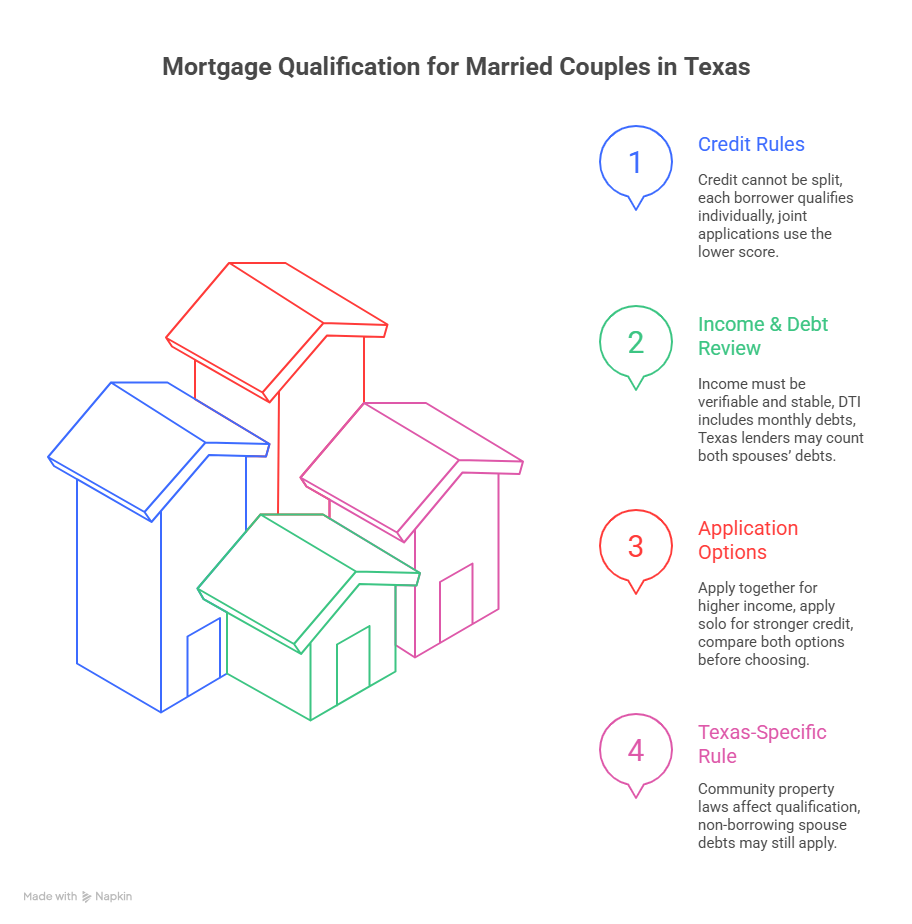
If you’re applying for a mortgage together, each borrower will need to qualify using their own credit score. Lenders can evaluate a joint application that combines both your scores and income, or a single-borrower application, but they cannot combine one spouse’s stronger credit with the other’s higher income.
The longer answer isn’t quite as black-and-white. Because Texas is a community property state – meaning spouses are considered equal owners of most assets and debts acquired while married – married couples often run into rules that don’t exist elsewhere. Even when only one spouse applies for the loan, the other spouse’s debts may still matter.
But the good news is that couples with uneven credit or income aren’t automatically stuck. There are multiple ways to structure a mortgage application. The key is understanding how Texas lending rules actually work so you can choose the approach that puts you in the strongest position.
Understanding Texas Community Property Laws
Texas is a community property state, which directly affects mortgage qualification.
Key points to understand:
- Any property acquired during marriage is considered jointly owned
- Both spouses may be listed on the deed, even if only one is on the loan
- Many loan programs consider both spouses’ debts due to community property laws
In practice, this is one of the most common areas where borrowers are surprised during underwriting, which is why guidance from a Texas-based loan officer matters.
A Real-Life (But Extreme) Example of How Texas Community Property Laws Play Out
Sometimes it can be hard to see how these rules play out in real life. We once had a client who was applying for a VA loan, but his wife had significant debt. Because Texas is a community property state, VA loan guidelines required that her debt be included in his debt-to-income calculation, even though she was not applying for the loan.
“Would the debt still count if we got divorced?” he asked us. Technically speaking, once you are legally divorced from someone, their debts wouldn’t apply. In this rare situation, the client did proceed with a divorce. That removed the community property debt from consideration, allowing us to secure him a VA loan. This is NOT a recommendation and not something we expect borrowers to pursue.
The right choice in your specific case will depend on your credit strength, income, and total debt. What works for one borrower may not be right for another.
Running both scenarios can help you identify valuable differences in potential interest rates, approval odds, and monthly payments. As long as you’re up front with us about any potential issues, such as debt or income changes, we can help you make the best choice for your loan application - without drastic or unnecessary steps.
The Simple Financial Rule Borrowers Need to Know
The way mortgage loans work is that each borrower must qualify based on:
- Their own credit score
- Their documented income
- Their existing debts
If both spouses apply together for a joint mortgage, lenders evaluate both credit profiles and combined income. If only one spouse applies, the lender reviews that spouse’s credit and income, with additional Texas-specific considerations.
These restrictions apply most often to federal loan programs, such as FHA, VA, and USDA loans. Conventional loans offer more workarounds but come with tighter restrictions and higher down payments.
Conventional Loans vs. FHA, VA, and USDA Loans in Texas
Not all mortgage programs treat spousal debt the same way, especially in a community property state like Texas.
Federal loan programs, including FHA, VA, and USDA loans, follow government-backed underwriting guidelines. In community property states like Texas, lenders must consider both spouses’ debts when calculating the debt-to-income ratio, even if only one spouse is applying for the loan. This is where many borrowers are caught off guard.
Conventional loans, which are not government-backed, can offer more flexibility. In many cases, a conventional loan will allow lenders to exclude a non-borrowing spouse’s debts from DTI calculations. However, that flexibility often comes with tradeoffs, such as:
- Higher credit score requirements
- Larger down payments
- Stricter overall underwriting standards
Because of these differences, the type of loan program you choose can significantly affect how spousal debt is treated and which application structure makes the most sense.
What You Can Choose Instead
Married couples in Texas generally have two options when it comes to applying for a mortgage:
- Apply jointly, with both spouses on the loan
- Apply solo, with only one spouse on the loan
Both approaches are commonly used, and neither is automatically better than the other.
Side note: Even if only one spouse is on the loan application, both spouses may have their names on the deed to the home once the purchase is complete.
In real life, choosing between these Texas mortgage application options usually comes down to how your credit scores compare, how much income is needed to qualify, and whether community property debts affect your debt-to-income ratio. Some couples apply together and qualify easily, while others are surprised to learn that a solo application actually creates a stronger overall loan profile.
Because of that, experienced Texas lenders will run both scenarios before recommending the approach that puts you in the best position.
How Texas Lenders Determine Your Credit and Income Eligibility
Mortgage lenders follow a specific review process, beginning with credit checks and then moving to income and debt assessments.
How Credit Scores Are Used on Mortgage Applications
Texas mortgage lenders evaluate credit differently from most consumer loans:
- Each borrower has three credit scores (one from each credit bureau)
- Mortgage lenders typically use the middle score of the three, not an average
- On joint applications, the lower middle score is used (the lower of the two middle scores between spouses)
Example:
Spouse A has a middle score of 720, while Spouse B has a middle score of 640. The qualifying score for the loan will be 640, the lower middle score.
This catches a lot of couples off guard, especially when one spouse has excellent credit and the other is still rebuilding. For solo applications, only the applying spouse’s credit scores are evaluated.
How Mortgage Lenders Calculate Income and Debt
Once mortgage lenders check out your credit score, they’ll shift their focus to income and debt. Lenders are looking for consistent, verifiable income that’s expected to continue.
From there, lenders calculate your debt-to-income ratio, or DTI. This compares your total monthly debt obligations (what you’re expected to pay back each month, such as credit card minimums or installment loans) to your gross monthly income.
Lenders need to be clear on how much you can afford as a mortgage payment alongside your existing financial responsibilities.
Debts included on DTI scores typically include:
- Credit cards
- Auto loans
- Student loans
- Personal loans
- Other mortgages
Here’s where that Texas-specific community property law comes into play.
In Texas, even when applying solo, many loan programs will still consider the non-borrowing spouse’s debts when calculating DTI, due to community property laws.
This means your spouse’s debts may still be reviewed, even if they are not on the loan.
The Pros and Cons of Applying Together vs. Solo on a Texas Mortgage
Choosing between a joint or solo mortgage application can impact everything from your approval odds to your interest rates, so it helps to understand how the options compare.
Applying Together (Joint Mortgage)
Pros
- Higher combined income may increase buying power
- Shared responsibility for the loan
- Useful when both spouses have strong credit profiles
Cons
- One spouse’s lower credit score can raise the interest rate offers
- Both spouses’ debts increase DTI
- Credit issues from one spouse can affect approval odds
Applying Solo (One Spouse on the Loan)
Pros
- You can choose the stronger credit profile
- May result in better interest rates
- It can be helpful when one spouse has poor credit
Cons
- A single income may limit the loan size
- Texas community property laws still apply
- Non-borrowing spouse’s debts can impact DTI
Comparison Table: Joint vs. Solo Mortgage Applications in Texas
Check out this table to see how joint and solo mortgage applications are reviewed under Texas lending guidelines.
|
Category
|
Joint Application
|
Solo Application
|
|
Credit Scores Used
|
Both spouses - lower middle score applies
|
Applying spouse only
|
|
Income Used
|
Combined income
|
Applying spouse’s income
|
|
Debts Considered
|
Both spouses’ debts
|
Both spouses’ debts (Texas laws)
|
|
Buying Power
|
Typically higher (2 incomes vs. 1)
|
May be limited by solo income
|
|
Interest Rate Impact
|
A lower credit score for one spouse can increase interest rates
|
Stronger credit may result in lower interest rate offers
|
|
Best For
|
Couples with similarly strong credit
|
Couples with uneven credit
|
Buying a Home in Texas with Poor Credit or Mixed Income
In Texas, the income gap between spouses can be significant. Recent data shows that men earn nearly 35% more than their female partners when both are fully employed.
When spouses have uneven credit or income, qualifying for a mortgage can feel more complicated. Luckily, there are plenty of practical options available when you work with an experienced loan officer.
What to Do When One Spouse Has Poor Credit
This can be where many buyers feel stuck. But even when one or both of you have bad credit, you can consider:
- Applying solo using the stronger credit profile
- Exploring loan programs with flexible credit requirements, such as FHA loans
- Working on short-term credit improvement strategies
Important Steps Before Applying for a Mortgage in Texas
- Pull credit reports and scores for both spouses to compare
- Calculate DTI for joint and solo scenarios, keeping in mind Texas laws
- Speak with a loan officer familiar with Texas lending rules
Reviewing both scenarios side by side can often help borrowers identify the most beneficial path forward.
Texas Mortgage FAQs: Spousal Credit and Income
These frequently asked questions address common concerns Texas borrowers have about using spousal credit and income when applying for a mortgage.
Can I get a mortgage using my husband’s income but not his credit?
No. Income can only be used if the earner is listed as a borrower, and each borrower must qualify using their own credit profile.
Can I use my spouse’s income to qualify for a mortgage in Texas?
Only if your spouse is listed as a borrower. Income cannot be used unless the earner is on the loan application.
Which spouse’s credit score is used for a mortgage?
For joint applications, lenders use the lower middle score (the lower of the two middle scores between spouses). For solo applications, only the applying spouse’s score is used.
Will a lender pull my spouse’s credit if they aren’t on the loan in Texas?
In many cases, lenders do not pull a full credit report for a non-borrowing spouse, but their debts can still be considered to calculate DTI under Texas community property laws.
Making the Right Mortgage Choice as a Married Couple in Texas
You can’t mix one spouse’s credit with the other spouse’s income on a mortgage application. But that does not mean married buyers in Texas are out of options. The most effective approach is to:
- Understand Texas community property laws and how they’ll impact your application
- Review joint and solo application options for the most positive profile
- Work with an experienced Texas lender who runs both scenarios
If you have questions about your specific situation, our team at Texas United Mortgage is happy to walk you through your options and explain how Texas community property laws may affect your loan.
Get in touch with us today!









Comments