Can you buy a home in Texas with no money down using FHA? Eligible buyers may use down payment assistance to cover FHA’s required down payment. Allowable seller credits can help with closing costs. Together, these may reduce the cash needed at closing, but approval, assistance terms, and the final settlement figures determine the result.
Cash back at closing means a refund of eligible money you already paid, such as earnest money—not extra spending money or unused seller credits.
Looking for a no money down home loan in Texas, or a way to buy a home with no down payment money and nothing out of pocket? Most buyers assume FHA always means bringing 3.5% to closing, plus closing costs. For a lot of Houston families, the cash is the real wall: the down payment, the closing costs, the prepaid taxes and insurance. On a $300,000 FHA purchase, that can easily add up to $20,000 or more.
This post walks through a real deal we're structuring right now for a couple buying in northeast Houston (77044). Their goal was simple: get into the house with $0 out of pocket, or at least under $1,000. They won't use any of their own money for the down payment, they'll have nothing out of pocket for closing costs, and they'll get cash back at closing. Here's exactly how we set it up, the trade-offs, and the math behind the decision.
Can You Get a 0 Down FHA Loan?
On its own, no. FHA generally requires at least 3.5% down for eligible borrowers; some borrowers must put down more. But that down payment doesn't have to come from your savings. When you pair an FHA loan with down payment assistance, the assistance can cover the entire 3.5%, which makes it work like a zero down FHA loan.
In Texas, one of the most common ways to do this is through the Texas State Affordable Housing Corporation (TSAHC), which offers assistance of up to 5% of the total loan amount. In this deal we're using 4%, which covers the full FHA down payment with room to spare. That takes care of the down payment money. Then seller credits for closing costs and the seller paying for title take care of the rest, so the buyer has nothing out of pocket. Put together, that's a true no money down purchase.
The trade-off is usually a higher interest rate and income limits you have to fit under. We'll walk through both below so you can decide whether it makes sense for you.
Start With the Goal, Then Build the Deal Around It
Every loan structure is a set of trade-offs. A lower rate, a lower payment, less cash at closing: you usually can't max out all three at once. So the first question we ask isn't "what's the lowest rate?" It's "what are you trying to accomplish?"
For this couple, the answer was clear. They have solid income and can handle the monthly payment, but they didn't want to drain their savings to buy the house. Keeping cash in the bank for emergencies, furniture, and life mattered more to them than squeezing out the lowest possible rate. Once we knew that, every other piece of the deal fell into place.
The Scenario at a Glance
- Purchase price: $300,000
- Loan program: 30-year fixed FHA
- Required FHA down payment (3.5%): $10,500
- Base loan amount: $289,500 (about $294,566 with the FHA upfront mortgage insurance financed in)
- Down payment assistance: TSAHC 4% forgivable second lien, 4% of the $294,566 total loan amount, or about $11,783
- Estimated total monthly payment: about $2,940 (principal and interest, taxes, insurance, and FHA mortgage insurance)
Without any help, this buyer would need roughly $23,400 in cash to cover the down payment, closing costs, and prepaids. Here's how we take that number to zero.
The Three Pieces That Make It Work
1. A Seller Credit Built Into the Offer
The seller credit isn't something you ask for after you're under contract. It has to be strategically planned and written into the offer from day one. In this deal we're structuring a $10,000 seller credit toward the buyer's closing costs and prepaids.
Working with your agent, the offer price and the credit are negotiated together. Sometimes that means offering a little closer to list price in exchange for the credit. The monthly impact of a slightly higher price is small. The cash impact of a $10,000 credit is huge.
FHA generally permits interested-party contributions of up to 6% of the sales price toward eligible costs, subject to actual costs and program rules. Seller credits cannot fund the buyer’s required down payment or be paid out as unused cash. See the HUD FHA Single Family Housing Policy Handbook. This example stays below the percentage cap.
2. The Seller Pays for the Title Policy
The second piece is getting the seller to cover the title insurance policy, about $1,741 in this scenario. That's another cost that would otherwise come straight out of the buyer's pocket. Together, the seller credit and seller-paid title come to about $11,741, or roughly 3.9% of the price.
3. 4% Down Payment Assistance as a Forgivable Second Loan
The third piece covers the down payment. Through the Texas State Affordable Housing Corporation (TSAHC), the buyer receives 4% of the total loan amount, about $11,783, structured as a second lien that has:
- No monthly payment
- 0% interest
- Full forgiveness on the third anniversary of closing
That's more than the $10,500 down payment, so the buyer brings no down payment money of their own. Forgiveness depends on meeting the applicable occupancy and loan conditions through the third anniversary. See TSAHC’s repayment and forgiveness explanation.
Cash Back With Your Keys
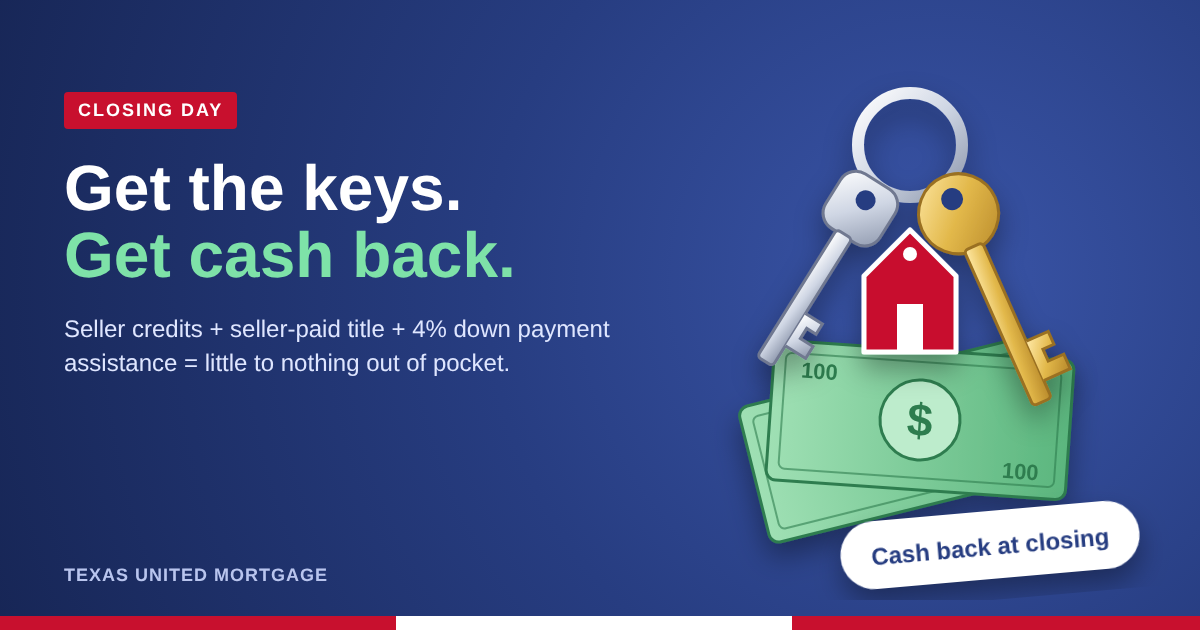
Here's where it gets fun. Put all the pieces together:
- Total due at closing (down payment, closing costs, prepaids): about $28,458, including $5,066 of FHA upfront mortgage insurance that gets financed into the loan
- Earnest money deposit already paid: $3,000
- Seller credit: $10,000
- Seller-paid title policy: $1,741
- Financed FHA upfront mortgage insurance: $5,066
- TSAHC 4% down payment assistance: $11,783
The credits come to more than the cost of closing. So instead of bringing money to the closing table, this buyer walks out with their $3,000 back along with the keys.
That cash back is the earnest money they put down when they signed the contract. FHA limits cash back to money the buyer already paid out of pocket, so the buyer can get their earnest money back but can't walk away with more than they put in. Any small extra credit is applied to the loan or trimmed from the seller credit at closing. When it's all said and done, their total out of pocket is $0. (Upfront items like an inspection or an appraisal paid before closing are the only other costs to plan for.)
The Trade-Off: A Higher Rate
Down payment assistance isn't free. Loans paired with assistance typically carry a higher rate than the same loan where the buyer brings their own down payment. In this example, we'll assume the rate is 0.75% higher with the assistance:
- Bringing their own down payment at 6.75%: about $1,911/month principal and interest
- Using 4% assistance at 7.50%: about $2,060/month principal and interest
- Difference: about $149 more per month
Rates are examples only and change daily. Your rate depends on credit, loan program, and market conditions.
The Downside: Selling or Refinancing Before Year 3
The assistance is forgiven after three years. If you sell, refinance, or pay off the first mortgage before the third anniversary, the full $11,783 has to be paid back, usually out of the sale or refinance proceeds.
That's the main risk. If there's a real chance you'll move or refinance in the first couple of years, you need to know that going in. Paying it back isn't the end of the world, since it's money you would have had to put down anyway, but you'd also have paid the higher rate in the meantime.
The Upside: Refinance in Years 3 to 4 and Come Out Ahead
Now look at it from the other side. If rates improve and the buyer refinances after the third anniversary, the $11,783 is already forgiven. They never pay it back.
- Refinance at 3 years (36 months): about $5,370 in extra payments vs. $11,783 in assistance they keep. About $6,400 ahead.
- Refinance at 4 years (48 months): about $7,160 in extra payments vs. $11,783. About $4,600 ahead.
And that's before counting what it's worth to keep $11,783 of your own money in savings for those years instead of handing it over at closing.
When Would the Assistance Stop Paying Off?
The longer you keep the higher-rate loan, the more the extra $149 a month adds up. If the buyer never refinances:
- On payment alone, the extra cost equals the $11,783 of assistance at about month 79, or about 6½ years.
- Counting that the higher-rate loan also pays down principal a little slower, the true break-even comes a bit sooner, around month 64, or about 5⅓ years.
So the sweet spot is clear. If you're likely to refinance or sell between year 3 and roughly year 5, the assistance more than pays for itself. If you plan to keep the same loan for 6+ years, bringing your own down payment for the lower rate may cost less in the long run. But that only matters if you have the cash, and getting into the home without draining savings is the whole point here.
Income Limits: Make Sure You Qualify
TSAHC eligibility depends on the county, program, loan type, targeted-area status, and whether a Mortgage Credit Certificate (MCC) is included. Use TSAHC’s official county income and purchase price limits tool for the applicable limit rather than assuming one Houston-wide figure.
The couple in this example has about $128,000 in annual qualifying income. We must verify that income against the applicable program limit before confirming eligibility. Income-counting rules can include more than just the borrowers named on the loan; TSAHC’s published guidance includes specific rules for married couples and others liable on the mortgage.
TSAHC’s published credit guidance lists a 620 minimum FICO for FHA assistance loans, with additional requirements for certain scores and manual underwriting. Lender requirements may be stricter. Review the official credit and debt requirements with your loan officer.
The Bottom Line
There's no single "best" loan. There's the loan that best fits what you're trying to accomplish. For this couple, the goal was to get the keys without emptying their savings, and with a well-built offer, a seller credit, seller-paid title, and 4% forgivable assistance, they're buying with no down payment money and nothing out of pocket, and getting cash back at closing instead of writing a check.
If you want to see what a no money down structure could look like for you, including your income limit, your payment, and how much seller credit to build into your offer, start your custom quote here and we'll map it out together.
This is an example for illustration only and not a commitment to lend. Rates, fees, assistance terms, and program guidelines are subject to change. All loans are subject to credit approval, property eligibility, and program requirements. Texas United Mortgage, NMLS #2442778.
Frequently Asked Questions About No Money Down FHA Loans in Texas
Does FHA offer a zero-down loan?
FHA still requires a down payment. Eligible assistance, gifts, or other permitted sources may cover that requirement so the buyer does not have to use personal savings for it.
Can seller credits cover my FHA down payment?
No. Seller credits may cover eligible closing costs and other permitted expenses, subject to limits. The required down payment must come from an acceptable separate source.
Can I get cash back at closing on an FHA purchase?
A refund of documented eligible funds you previously paid may be permitted, subject to FHA, assistance-program, and lender rules. It is not permission to receive unused seller credits as extra cash.
Do I have to repay TSAHC down payment assistance?
It depends on the assistance option. This example uses a three-year deferred forgivable second lien. Selling, refinancing, or otherwise triggering repayment before forgiveness can require full repayment; review the actual loan documents.
Does no money down mean I need no money before closing?
Not necessarily. Earnest money, inspections, appraisal fees, and other upfront expenses may still be due. Refunds and eligible costs depend on the final loan structure, so plan for upfront expenses.
Is down payment assistance always the cheapest option?
No. Compare the interest rate, fees, repayment conditions, and expected time in the loan against the assistance received. A future refinance is not guaranteed and has its own qualification requirements and costs.
About the Author
Reef Merhi, NMLS #878539, is the owner and president of Texas United Mortgage, NMLS #2442778, based in The Woodlands and serving Texas homebuyers. Explore Texas FHA loans or request a personalized loan review.
Program information reviewed November 1, 2026. This article describes an estimated purchase structure, not a completed closing or guaranteed outcome. Verify current guidelines and final figures with your loan officer.









Comments