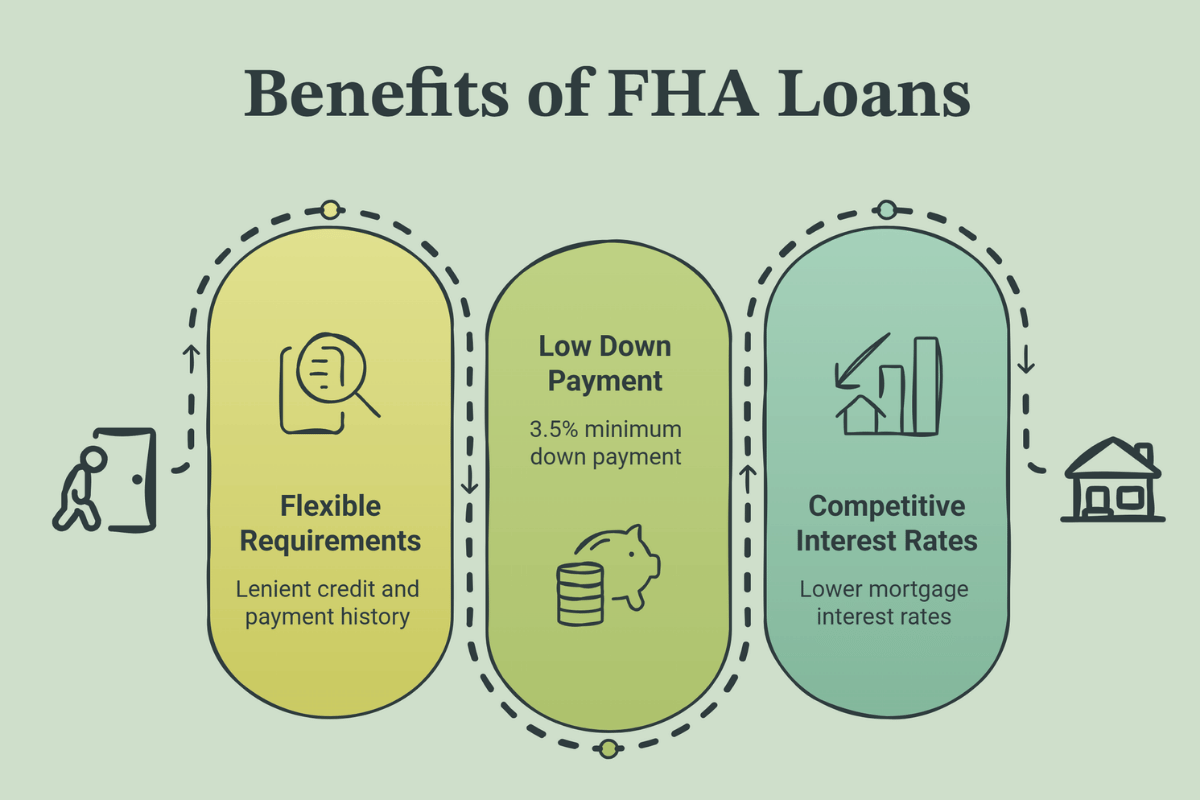
FHA loans offer flexible requirements, low down payment options, and competitive interest rates, making homeownership more accessible for first-time buyers and borrowers facing financial challenges.
However, they come with mortgage insurance premiums, loan limits, and strict property standards.
Below, I’ve summarized key FHA loan pros and cons to help Texas borrowers like you determine whether this home financing option is right for you.
What Are the Benefits of FHA Loans for Texas Buyers?
Insured by the Federal Housing Administration, FHA loans offer more accessible qualification standards than conventional loans.
These government-backed mortgages are ideal for borrowers with lower credit scores or smaller down payment, whether you're buying a traditional home or a manufactured home.
Here are some of the advantages of FHA loans:
Flexible Requirements
While borrowers with an unfavorable credit history and lower credit scores often struggle to qualify for many mortgage loans, FHA loans open a path to homeownership with more lenient credit requirements.
- If you have limited credit history, your lender may use verified nontraditional payment records, such as rent or utility payment history, to evaluate your ability to manage financial obligations.
- A past bankruptcy or foreclosure doesn’t automatically disqualify you. However, you must satisfy other loan requirements, such as meeting waiting periods, maintaining a solid payment history, and re-establishing good credit.
- While the maximum DTI for FHA mortgages is 43%, lenders may consider a higher DTI if you have strong compensating factors, such as substantial cash reserves.
- If there’s a co-borrower, you may add their qualifying income to improve your loan approval chances. FHA loans allow eligible non-occupant co-borrowers, such as family members or trusted friends.
Low Down Payment
FHA loans offer a low down payment advantage to qualifying applicants, including those with lower scores.
- Borrowers with a minimum 580 FICO score qualify for a 3.5% minimum down payment.
- If your credit score falls between 500 and 579, you may still qualify for an FHA loan with a minimum 10% down payment.
For example, based on the June 2026 median single-family home price of $345,000 in Houston, you’ll need a $12,075 down payment when putting down 3.5% or $34,500 when putting down 10%.
Down Payment Assistance and Cash Gifts
Various statewide down payment assistance programs are available in Texas to reduce your upfront expenses.
If you’re eligible, you can pair your FHA mortgage with these programs:
- TDHCA My First Texas Home
- TDHCA My Choice Texas Home
- TSAHC Home Sweet Texas
- TSAHC Homes for Texas Heroes
- SETH MyHome Plus
- SETH 5 Star Texas Advantage
- SETH Buyer Select
Check local programs as well. For example, Houston’s Homebuyer Assistance Program offers up to $75,000 in assistance (a no-interest, forgivable loan) to income-qualified residents.
Additionally, the FHA allows you to use cash gifts. You must provide a gift letter detailing who the benefactor is and the monetary amount, confirming that you don’t need to repay the funds.
Competitive Interest Rates
FHA loans offer lower mortgage interest rates for more affordable housing payments.
Your credit score, down payment, income, loan amount, and debt levels affect your interest rate. It’s best to improve your credit score and reduce your monthly debts to show lenders that you’re creditworthy and qualify for better loan terms.
Your loan term is also a key factor. For example, a 15-year FHA loan may have a lower rate than a 30-year loan.
Pro Tip: Be sure to shop around and compare quotes from three or more lenders to find the best terms. You may also pay discount points at closing in exchange for a lower mortgage rate. One discount point equals 1% of your loan amount, although the exact rate reduction varies by lender and market conditions.
Are There Drawbacks?
Consider the following disadvantages before getting an FHA loan:
Mortgage Insurance Premiums (MIP)
Mortgage insurance helps protect your lender in case you default on your loan.
- Upfront Mortgage Insurance Premium (UFMIP) - This is 1.75% of your base loan amount. You may pay it in full at closing or add it to your loan.
- Annual MIP - This is added to your monthly payment. It ranges between 0.15% and 0.75% of your mortgage balance and eventually decreases as your mortgage balance declines.
If you put down at least 10%, you can cancel your mortgage insurance after 11 years as long as you meet all other necessary requirements.
Property Requirements
To confirm that your home meets the property standards set by the FHA, your lender will require an FHA home appraisal. A professional appraiser will check whether the property is safe, secure, and free of structural defects.
Properties with significant issues, such as foundation damage, may not qualify for an FHA loan.
Loan Limits
The maximum amount you can borrow depends on your location and changes every year.
In Texas, the FHA loan limits as of July 2026 range between $541,287 and $813,050 for single-family homes.
Use the FHA Mortgage Limits tool on the official U.S. Department of Housing and Urban Development (HUD) website to check the loan limits for your area.
Get Preapproved for an FHA Loan
Once you’ve weighed the pros and cons of an FHA loan in Texas, your next step is to determine whether you meet all eligibility requirements.
Our experienced mortgage experts at Texas United Mortgage will guide you through the application process and help you lock in a competitive interest rate.
Reach out to us to get preapproved today and explore your financing options.
Next, find out what an FHA 203(k) loan is and why it's a good fit for homebuyers looking for a fixer-upper.









Comments