




Table Of Contents
Property taxes can raise or lower your total monthly mortgage payment if the local tax rate or your home’s assessed value changes, even if you have a fixed-rate loan.
Read on to discover the impact of property taxes on monthly mortgage payments in the Lone Star State. I’ll also provide sample tax calculations using median home values.
How Do Property Taxes Affect My Mortgage Payment in Texas?
Property taxes in Texas are among the highest in the United States.
Texas ranks seventh-highest in U.S. property tax rates, with an effective tax rate of 1.40%, according to a report by the Tax Foundation. This means many Texas homeowners pay higher property taxes than those in lower-tax states.
- Changing Tax Amount: Property taxes can change based on your home’s appraised value, homestead exemptions, and local tax rates. Even if your principal and interest stay the same, your total monthly mortgage payment may increase if your home’s value rises.
For example, KHOU reported that a Houston couple’s monthly mortgage payment nearly doubled, jumping from $1,700 to around $3,200 after a sharp increase in property taxes and an escrow shortage. Their home’s appraised value increased significantly from $225,000 to roughly $470,000.
However, a loan officer informed them that the substantial change wasn’t typical. They were advised to file a protest with the appraisal district and submit any missing paperwork to cap the taxable value of their residence and claim tax relief.
The City of Houston Housing and Community Development Department said the couple failed to submit the required paperwork on time, which is why they didn’t receive tax relief.
Be sure to stay on top of your escrow account, submit any important paperwork on time, and file a protest with your local appraisal district if you think the property value is too high.
Pro Tip: Use our free Texas MUD tax calculator to know one component of your property tax bill. We also have a free homestead exemption calculator to help you get an idea of your potential savings.
Sample Calculation of Texas Property Taxes
Property tax rates vary widely by county, city, and school district. For example, Austin County has a 1% effective property tax rate, while Dallas County has a 1.45% effective rate.
On a median housing value (Austin) of $296,900 with a 1% property tax rate, you’d pay $2,969 annually or $247 monthly in property taxes.
In comparison, you’d pay $4,394 per year or $366 per month in property taxes on a median home value of $303,000 (Dallas) with a 1.45% property tax rate.
Do Mortgage Payments Include Property Taxes?
For many Texas homeowners, the monthly mortgage payment already includes property taxes.
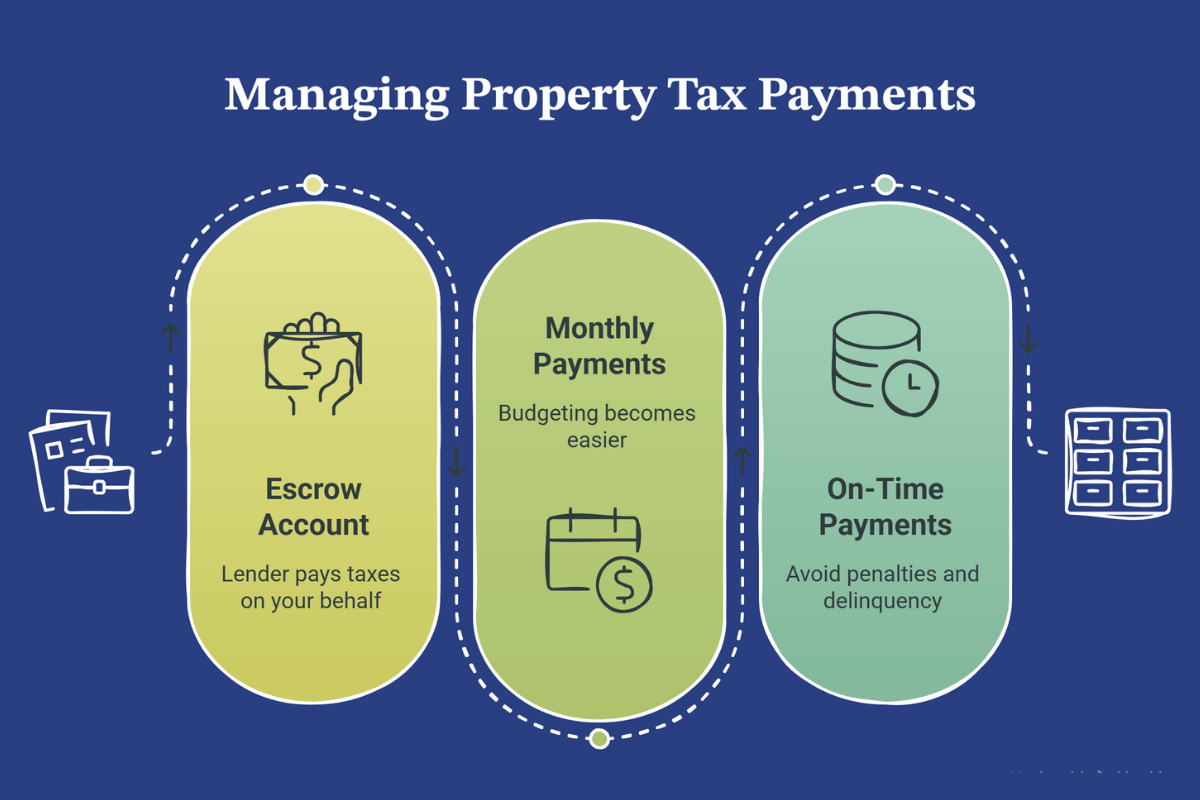
Mortgage lenders in Texas usually require an escrow account to collect and hold funds for property taxes and homeowners’ insurance. This means your lender pays the taxes on your behalf, simplifying the payment process.
An escrow account is required when:
- You have a government-backed loan, such as a VA, USDA, or FHA loan.
- You make a down payment of less than 20% on a conventional loan.
Your lender will estimate your annual property tax bill and divide it into 12 monthly escrow payments. This way, budgeting becomes easier because you pay a smaller amount per month instead of one large annual bill.
Escrow also helps ensure on-time payments, which are important since unpaid property taxes can become delinquent and lead to penalties.
However, if escrow is optional and you decide not to use it, you become responsible for paying your property tax bill directly every month. In this case, be sure to set aside money for tax payments and avoid missed deadlines.
Pro Tip: Contact your loan servicer to confirm that your monthly mortgage payment includes property taxes. Review your escrow analysis every year to understand how tax rate changes are affecting your bill.
Escrow Shortage Vs Escrow Surplus
An escrow shortage often happens when the property tax rate increases, and your escrow account doesn’t have enough funds to cover the increased payment.
In some cases, your loan servicer may cover the difference. You can pay the amount back in full or through monthly installments, which will be added to your monthly mortgage payments.
On the other hand, an escrow surplus occurs when your escrow account has extra funds, usually due to lower taxes. Your servicer may use the money for future escrow payments or send you a refund.
Tips for Texas Homebuyers
Keep these tips in mind to manage your property taxes:
- Compare tax rates by county before choosing where to buy a home. Besides checking the home price, it’s best to compare estimated property taxes for different locations. A higher local tax rate can increase your monthly payment even when the purchase price is lower.
- Apply for the Texas residence homestead exemption to lower your home’s taxable value, particularly for school district taxes. A lower taxable value reduces your annual property tax bill.
- Ask your local appraisal district whether you qualify for other exemptions, such as a disabled veteran exemption, surviving spouse exemption, disability exemption, or over-65 exemption. If you’re a disabled veteran, the property tax bill may be eliminated entirely, depending on your disability rating.
- Check your notice of appraised value every year to ensure the county’s value remains accurate. If you notice any errors or disagree with the appraisal district’s value, you may file a protest with the appraisal review board to lower your home’s appraised value.
Remember: Your lender must adjust your escrow contributions based on approved exemptions. Review your appraisal district records and inform your lender if there are updated exemption notices.
Get Assistance From a Licensed Loan Officer
Want to know more about taxes, insurance, and other components of your monthly mortgage payment? Our home loan experts are ready to answer any questions you have about the homebuying process.
We’ve helped hundreds of Texas homebuyers compare loan options and choose terms that match their financial situation.
Contact us today to start your application!




Subscribe Newsletter
Get instant blog update right into your mail box
Comments