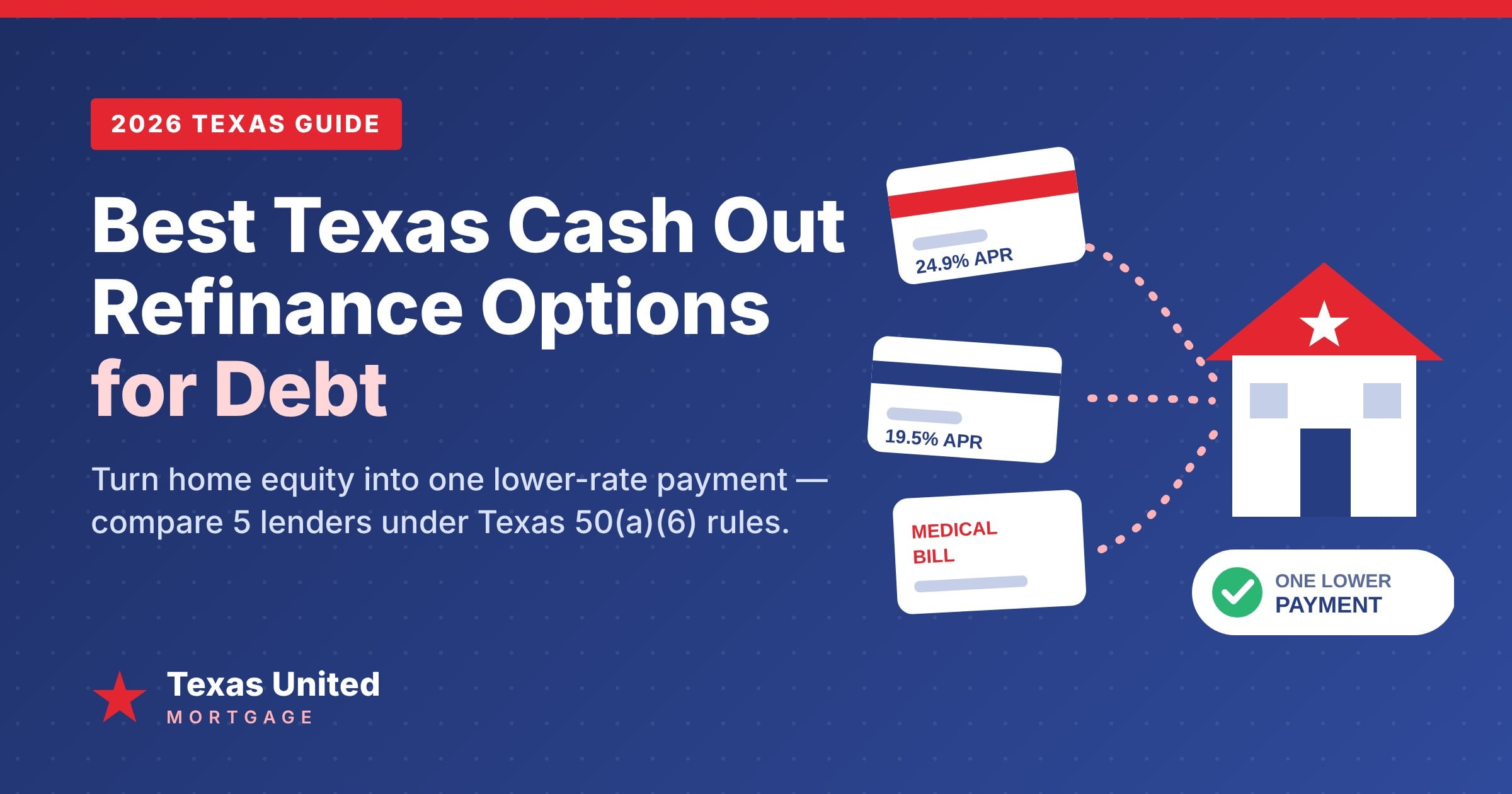
If you're a Texas homeowner making minimum payments on credit cards and watching the balances barely move, you're not alone. High-interest cards, multiple due dates, and interest that eats most of every payment can leave you feeling stuck. A cash out refinance in Texas lets you use your home equity to pay off that debt and roll it into one lower monthly payment.
In this article, we'll walk through a real Texas United Mortgage client's numbers, show the math behind consolidating credit card debt into your mortgage, explain the Texas rules you need to know, and compare the top cash-out refinance options for debt consolidation in Texas.
A real example: $72,000 in credit card debt rolled into one payment
One of our recent clients came to us carrying more than $72,000 in credit card debt, with some cards charging 29.99% interest. On one card alone, his minimum payment was over $1,000 a month, and roughly $900 of that was interest. He was making every minimum payment on time, but the balances were going nowhere.
Like many homeowners, he held off on refinancing for a long time because he didn't want to give up the low rate on his existing mortgage. When we ran the numbers together, the picture was clear:
| Monthly payment |
Before refinance |
After cash-out refinance |
| Mortgage (principal and interest) |
$2,250 |
$2,500 |
| Credit card payments |
$3,000+ |
$0 |
| Total |
$5,250+ |
$2,500 |
Payments shown exclude property taxes and homeowners insurance.
His new mortgage rate is a little higher than his old one, and his mortgage payment went up by about $250. But he eliminated more than $3,000 a month in credit card payments. That's roughly $2,750 a month back in his budget, one due date instead of many, and no more 29.99% interest working against him.
Why a slightly higher mortgage rate can still save you money
The biggest reason homeowners wait is fear of losing a low mortgage rate. But the rate on your mortgage is only part of the story. What matters is the total interest you pay across all of your debt. When a large share of your monthly budget is going to 25% to 30% credit card interest, a slightly higher mortgage rate on one consolidated loan can cost far less overall.
The real power comes from what you do with the savings. If you put part of the money you were sending to credit card companies toward your mortgage principal, you shorten your loan term, and the interest rate becomes much less of a factor.
For illustration only: on a hypothetical $385,000, 30-year loan at 6.75% (a principal and interest payment of about $2,500), adding $1,000 a month toward principal would pay the loan off in about 14.5 years instead of 30 and save roughly $297,000 in interest. Your numbers will depend on your loan amount, rate, and how much extra you pay. This is not a rate quote. See today's mortgage rates in Texas for current pricing.
A cash-out refinance for debt works best when you:
- Are carrying high-interest credit card or personal loan balances that aren't going down
- Have enough equity to stay at or below 80% of your home's value after the refinance
- Plan to keep the cards paid off rather than running the balances back up
- Can put some of the monthly savings toward principal to pay the loan off faster
Spreading credit card debt over a 30-year mortgage can cost more in total interest if you only make the minimum mortgage payment for the full term. That's why we build a payoff plan with you, not just a new loan. Your new rate also applies to your entire mortgage balance, not only the cash-out portion, so your loan officer will compare both scenarios side by side before you decide.
How does a Texas cash-out refinance work for debt consolidation?
A Texas cash-out refinance replaces your existing mortgage with a new, larger loan. You receive the difference between the old balance and the new loan amount, which can be used to pay off credit cards, personal loans, medical bills, or other high-interest debt.
Texas regulates cash-out refinances under Article XVI, Section 50(a)(6) of the Texas Constitution. The new loan cannot exceed 80% of your home's appraised value, and you must wait at least 12 months after a previous cash-out refinance before completing another one. Because of these rules, lenders rarely close FHA or VA cash-out refinances in Texas, so most Texas cash-outs are done with conventional financing.
For example, if your home is appraised at $400,000 and you owe $250,000, you could potentially borrow up to $320,000 (80% of $400,000) and receive up to $70,000 to eliminate high-interest balances. Texas United Mortgage helps you run these numbers with a refinance calculator so you can see your potential savings before applying.
How do today's mortgage rates compare to your credit card debt?
Mortgage rates change daily, but they are typically a fraction of what credit cards charge. Credit card interest rates often run above 20%, and many cards charge close to 30%, while mortgage rates are generally far lower because your home secures the loan. That gap is what makes a cash-out refinance such a powerful tool for debt consolidation.
To see where rates stand right now, check today's mortgage rates in Texas, which Texas United Mortgage updates regularly. Cash-out refinance rates can run slightly higher than purchase rates, and your actual rate depends on your credit score, loan amount, and equity. For your exact numbers, request a free custom quote.
Quick guide: 5 best cash out refinance options for Texas debt consolidation
- Texas United Mortgage: The best overall cash-out refinance partner for Texas homeowners consolidating high-interest debt, with local 50(a)(6) expertise and a personalized payoff plan
- New American Funding: National lender with FHA, VA, and conventional programs, though Texas cash-outs generally require conventional financing
- Better Mortgage: Online application process with a streamlined digital closing workflow
- Navy Federal Credit Union: Available to military-connected borrowers who are members of the credit union
- Veterans United: Focused on VA-eligible borrowers, though VA cash-out refinances face major restrictions in Texas
How we chose the best cash out refinance lenders for debt consolidation in Texas
- Texas regulatory knowledge: Does the lender understand the 80% loan-to-value (LTV) cap, the 12-month waiting period, and other Section 50(a)(6) requirements?
- Clear credit requirements: Does the lender explain upfront that Texas cash-outs are generally conventional loans requiring a 620+ credit score, and offer alternatives if your score is lower?
- Debt consolidation support: Does the lender help you plan how to use your cash-out proceeds and pay your loan down faster, or simply hand you a check?
- Personalized guidance: Will you work with a dedicated loan officer, or navigate a self-service portal on your own?
The 5 best cash out refinance options for Texas debt consolidation
1. Texas United Mortgage: Best overall cash out refinance for Texas debt consolidation
Texas United Mortgage is a locally rooted lender headquartered in Spring, Texas, with deep knowledge of the state's constitutional rules governing cash-out refinances. The team structures a refinance loan that converts expensive balances into a single, lower monthly payment, then helps you build a plan to pay it down faster.
- Personalized loan structuring: Your loan officer builds multiple scenarios, including options for lower rates, fewer points, or no-points configurations, and compares them against keeping your current mortgage.
- Texas 50(a)(6) compliance expertise: The team handles every regulatory detail, from the 12-month waiting period to the mandatory cooling-off period before closing.
- Free rate quotes with no SSN required: Get an initial rate comparison without a hard credit pull.
- Clear credit guidelines: A conventional cash-out refinance requires a credit score of 620 or higher. If your score is below 620, your loan officer can walk you through other loan programs that accept lower scores.
- Debt payoff planning: We help you decide which debts to pay off and how to use your monthly savings to shorten your loan term.
Keep in mind: Texas United Mortgage lends only in Texas, and in-person consultations are centered in the Houston metro area, with phone and online support statewide.
2. New American Funding: National lender with multiple refinance programs
New American Funding lends in all 50 states and offers FHA, VA, and conventional programs, along with bilingual English and Spanish support. Its advertised credit score minimums as low as 580 apply to FHA and VA loans, which are generally not an option for Texas cash-outs under Section 50(a)(6). Texas homeowners consolidating debt will typically need a conventional cash-out refinance at 620 or higher.
3. Better Mortgage: Digital-first application with an online closing workflow
Better Mortgage is an online lender with no origination fee on select products, digital document upload, and rate locks available at preapproval. It suits borrowers who prefer a self-service process, but there are no in-person branches or dedicated local loan officers.
4. Navy Federal Credit Union: Available to military-connected borrowers
Navy Federal offers conventional and VA cash-out refinances to members, including active-duty military, veterans, and their families, with 24/7 member support. Membership is required, and in Texas every cash-out refinance, including VA, is capped at 80% LTV.
5. Veterans United: Focused on VA-eligible borrowers
Veterans United specializes in VA loans and offers VA cash-out refinances in many states, but Texas homeowners face major restrictions. Under Section 50(a)(6), any cash-out refinance in Texas, including VA, is capped at 80% LTV. That removes the higher-LTV advantage VA cash-outs offer elsewhere, and many lenders don't offer VA cash-outs in Texas at all. Veterans United does not offer conventional or FHA cash-out options.
Comparison table: The best cash out refinance options for Texas debt consolidation
| Lender |
Texas 50(a)(6) Expertise |
Minimum Credit Score (Texas Conventional Cash-Out) |
Assigned Loan Officer |
| Texas United Mortgage |
✓ |
620 |
✓ |
| New American Funding |
✗ |
620 (580 applies to FHA/VA only) |
✓ |
| Better Mortgage |
✗ |
620 |
✗ |
| Navy Federal Credit Union |
✗ |
Not published |
✓ |
| Veterans United |
✗ |
Not published |
✓ |
When is a cash-out refinance a smarter choice than a personal loan for debt consolidation?
A cash-out refinance typically carries a lower interest rate than a personal loan because your home serves as collateral. According to ICE Mortgage Technology's August 2026 Mortgage Monitor, American homeowners hold a record $18 trillion in mortgage equity, with 47.5 million borrowers sitting on $11.7 trillion in tappable equity.
Personal loans are unsecured, so they don't put your home at risk, but their rates tend to run significantly higher than mortgage rates. A personal loan may fit if you need a smaller amount quickly or don't have enough equity. For larger balances like our client's $72,000, a cash-out refinance usually saves far more. Your loan officer can compare both options with you.
Why Texas United Mortgage is the best cash out refinance option for Texas debt consolidation
National lenders process Texas loans using the same playbook they apply in every other state. Texas United Mortgage builds your cash-out refinance around Section 50(a)(6) compliance from day one, so there are no last-minute surprises at the closing table.
More importantly, we don't just hand you a check. We look at your whole financial picture, show you what you're paying today versus after the refinance, and help you build a plan to pay your loan down faster with the money you free up. That's how our client went from more than $5,250 a month in payments with balances going nowhere to one $2,500 mortgage payment and a clear path forward.
If you're tired of making minimum payments on high-interest cards, contact Texas United Mortgage today for a free rate quote and personalized savings analysis.
FAQs about cash out refinance for debt consolidation in Texas
Should I give up my low mortgage rate to pay off credit card debt?
It depends on your total debt picture, not just your mortgage rate. If you're paying 20% to 30% interest on large credit card balances, a slightly higher mortgage rate on one consolidated loan can lower your total monthly payments and your total interest, especially if you put part of the savings toward principal. A loan officer can compare keeping your current mortgage against a cash-out refinance so you can see the difference in real numbers.
What is the maximum LTV for a cash-out refinance in Texas?
Texas law caps cash-out refinance loans at 80% of your home's appraised market value under Section 50(a)(6) of the Texas Constitution. You must retain at least 20% equity in your home after the refinance. Texas United Mortgage helps you calculate your available equity before you apply.
How long do I have to wait between cash-out refinances in Texas?
You must wait at least 12 months after closing one cash-out refinance before completing another in Texas. This waiting period is set by the Texas Constitution and cannot be waived by any lender.
Can I use a cash-out refinance to pay off credit card debt?
Yes. There are no restrictions on how you use the cash from a Texas cash-out refinance. Many borrowers use the funds to pay off credit cards, personal loans, medical bills, or other high-interest obligations. Texas United Mortgage helps you plan your payoff strategy so you get the most savings from your refinance.
What credit score do I need for a cash-out refinance in Texas?
A conventional cash-out refinance with Texas United Mortgage requires a credit score of 620 or higher, which is the standard minimum for traditional cash-out financing. If your score is below 620, Texas United Mortgage offers other loan programs that accept lower credit scores, and your loan officer can help you find the option that fits your situation.
Why aren't FHA or VA cash-out refinances used in Texas?
It comes down to the 80% LTV limit. Texas cash-out refinances cannot exceed 80% of your home's value under Section 50(a)(6), but FHA and VA loans are built for borrowers with less equity. FHA loans are designed for higher loan-to-value financing with mortgage insurance, and VA loans are designed to allow up to 100% financing with a funding fee unless the veteran is exempt. Capping either loan at 80% LTV removes the very advantage it was designed for, so in practice lenders and investors rarely close FHA or VA cash-out refinances in Texas.
For most Texas homeowners, a conventional cash-out refinance is the right fit. It typically requires a credit score of 620 or higher, and with at least 20% equity remaining you avoid mortgage insurance altogether.
Is a cash-out refinance or a HELOC a smarter option for debt consolidation?
A cash-out refinance gives you a lump sum at a fixed interest rate, which makes budgeting predictable. A HELOC provides a revolving line of credit at a variable rate, which means your monthly payment could change. If you want to pay off a specific set of debts in one move, a cash-out refinance through Texas United Mortgage offers a fixed-rate, single-payment solution.








Comments