



Table Of Contents
To file for a general residence homestead exemption, complete the Residence Homestead Exemption Application form online and provide the necessary documents to the Tarrant Appraisal District (TAD).
Additional requirements vary depending on the type of homestead exemption.
Keep reading to know the step-by-step filing process and find out the requirements for common homestead exemptions in Texas.
Quick Facts About Homestead Exemption for Tarrant County Homeowners
A homestead exemption is a property tax benefit that exempts a portion or all of your primary residence’s value from taxation.
You can save hundreds or even thousands of dollars in property taxes if you’re a Texas homeowner, depending on your property's tax rate and the exemptions your local units offer.
- 20% Homestead Exemption (Maximum Allowed by Texas Law): For Tarrant County homeowners, the homestead exemption increased from 10% to 20% of a home’s appraised value in 2024 in response to rising home prices and property taxes. This means 20% of your home’s appraised value may be exempt from taxation when calculating Tarrant County and the Hospital District taxes. Around 404,000 accounts qualified for the exemption that year.
- No Fees: There’s no fee to apply for a residence homestead exemption in Texas.
- Homestead Cap: A homestead exemption also gives you a “homestead cap,” which limits increases in your property’s appraised value to 10% per year (excluding the value of additional improvements or significant renovations).
- Application Deadline: Be sure to submit your application before May 1, which is the filing deadline for the tax year.
How to File for a Homestead Exemption in Tarrant County
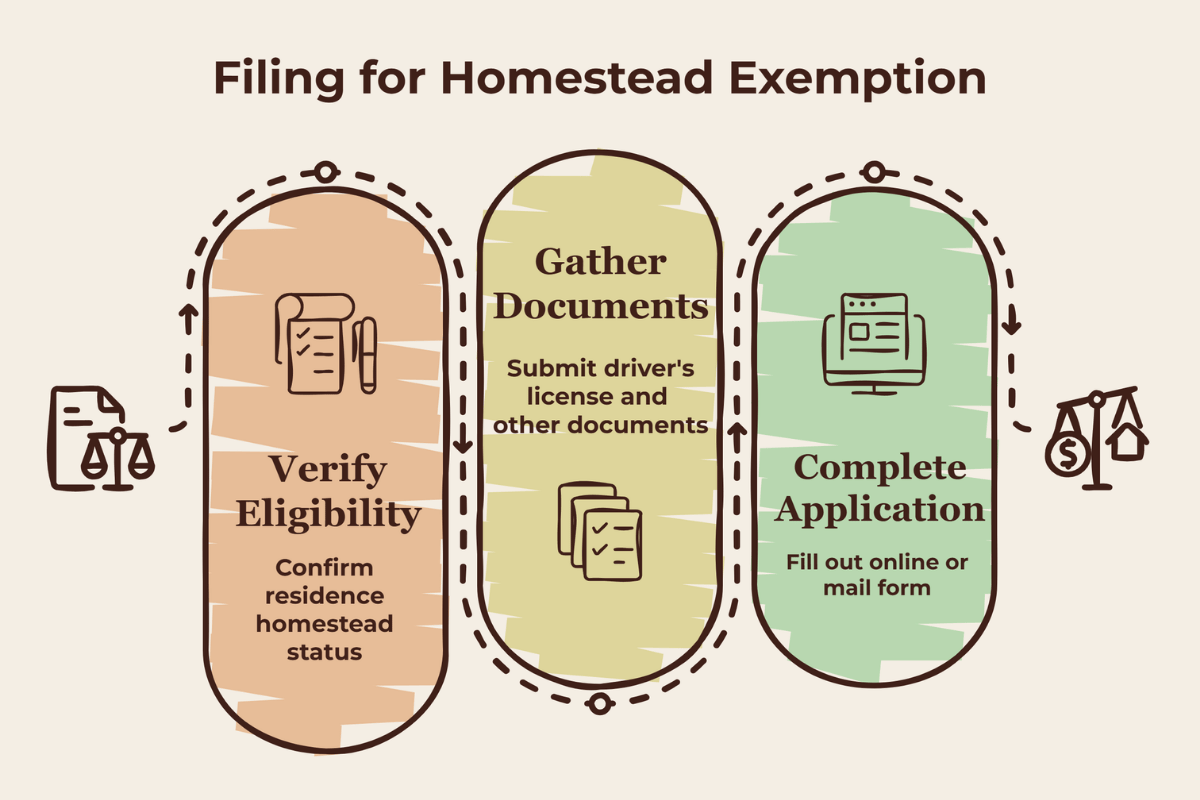
Follow these steps to complete your application:
1. Make sure you’re filing an exemption for a residence homestead.
- A residence homestead is a house, condominium, or manufactured home together with up to 20 acres of land for residential use.
- The property must be owned by one or more individuals, either directly or through a qualifying trust.
- You're a Texas resident who owns an interest in the property and occupy it as your principal residence on January 1.
Remember: Investment and business-owned properties usually don’t qualify for a residence homestead exemption. Also, agricultural and open-space appraisals differ from homestead exemptions, and they have their own application process and eligibility requirements.
2. Prepare the necessary documentation and requirements.
To apply online, you’ll need your:
- Driver’s license
- Property account number
- Online PIN
You may have to submit varying documents depending on the exemption. Here are common exemption types and their additional requirements:
General Residence Homestead Exemption
Qualifying Texas homeowners who own and occupy their primary residence may receive a $140,000 exemption from the property’s value when calculating school district taxes. Other local taxing units have the option to provide an additional exemption of up to 20% of the property’s appraised value.
For example, if you own a $350,000 home in Tarrant County, the $140,000 school district homestead exemption reduces the property’s taxable value for school taxes to $210,000. If your school district also offers the full 20% local homestead exemption, the taxable value becomes $140,000.
Requirements:
- Proof of ownership and Texas residency and occupancy, often a Texas driver's license or state-issued personal identification certificate, ensuring the address matches the homestead address.
- Must not claim a residence homestead exemption on another property in Texas or anywhere else.
Age 65 or Older or Disabled Persons Exemption
If you’re at least 65 years old or disabled, you may receive an additional $60,000 school district homestead exemption and a school tax ceiling, or tax freeze, that limits the amount of school taxes you pay annually unless you make significant home improvements, such as adding a pool or garage.
Other taxing units may also offer an extra local exemption of at least $3,000.
In Fort Worth, eligible elderly and disabled homeowners may receive an additional $80,000 homestead exemption.
Additional requirements:
- Age 65 or older: Must be at least 65 during the tax year, own the property, and live in the home as your primary residence.
- Disabled: Meet the Social Security Administration’s definition of disability. You must also provide supporting documents related to your disability if required. You’re not automatically eligible even if you’re receiving disability benefits from other programs.
- Surviving spouse: Must be 55 or older, continue to own the home, and use it as a residence homestead to receive the qualifying spouse’s tax benefits.
Disabled Veteran Exemption
For disabled Texas veterans, the property tax exemption amount varies depending on their service-connected disability rating.
Veterans with a 10% disability rating or higher may be eligible for a partial exemption.
Those who receive 100% disability compensation and have a 100% disability rating or individual unemployability are entitled to a full property tax exemption on their residence homestead.
Additional requirements:
- Must have a service-connected disability rating from the U.S. Department of Veterans Affairs or the U.S. armed forces branch where you served.
- A copy of documentation showing your service-connected disability rating.
- A surviving spouse must remain unmarried and meet certain property and residence requirements to keep the exemption.
Check the Tarrant Appraisal District’s official page to see the complete list of requirements for different homestead exemptions in Tarrant County.
Pro Tip: Use our free Texas homestead exemption calculator to get an idea of your tax savings. You can also use TAD’s online tax estimator to estimate your property taxes in Tarrant County.
3. Complete your online application on the TAD Homestead Exemption page.
Fill out the Residence Homestead Exemption Application form and provide any required documents. You’ll receive a submission confirmation number upon successful completion.
Alternatively, you can download the form and mail, hand-deliver, or email the completed form and supporting documents to TAD.
If TAD approves your homestead exemption, you likely don’t have to reapply annually unless your eligibility changes or TAD requires you to do so.
Understand Your Mortgage and Homeownership Costs in Texas
As a homeowner in Tarrant County, qualifying for a homestead exemption helps reduce your property tax burden and make housing costs more affordable.
If you’re planning to buy or refinance a home in Texas, our trusted loan officers at Texas United Mortgage will help you explore your financing options.
Get in touch with us today to discuss your home financing plans.




Subscribe Newsletter
Get instant blog update right into your mail box
Comments