In Texas, some mortgage programs require as little as 3% to 3.5% down payment. Some government-backed mortgages offer zero-down options for eligible borrowers.
If your savings fall short, you may qualify for state-sponsored down payment assistance programs that help ease the burden of upfront homebuying costs.
Keep reading to know how much the down payment is for a house in Texas based on the loan type. I’ll also explain what affects your down payment and how to determine the right amount for your home purchase.
Average Down Payment for Buying a Home
The median down payment among homebuyers in the United States was 19% of the purchase price in 2025, with 10% for first-time buyers and 23% for repeat buyers, according to the National Association of Realtors. [1]
In Texas, the average down payment was 10.7% and the median amount was $12,262 in 2025. [2]
That means many homebuyers in Texas are not waiting until they have the traditional 20% down payment. Instead, they choose to buy with a moderate or low down payment once they’re financially ready.
How Much Down Payment Do Lenders Require?
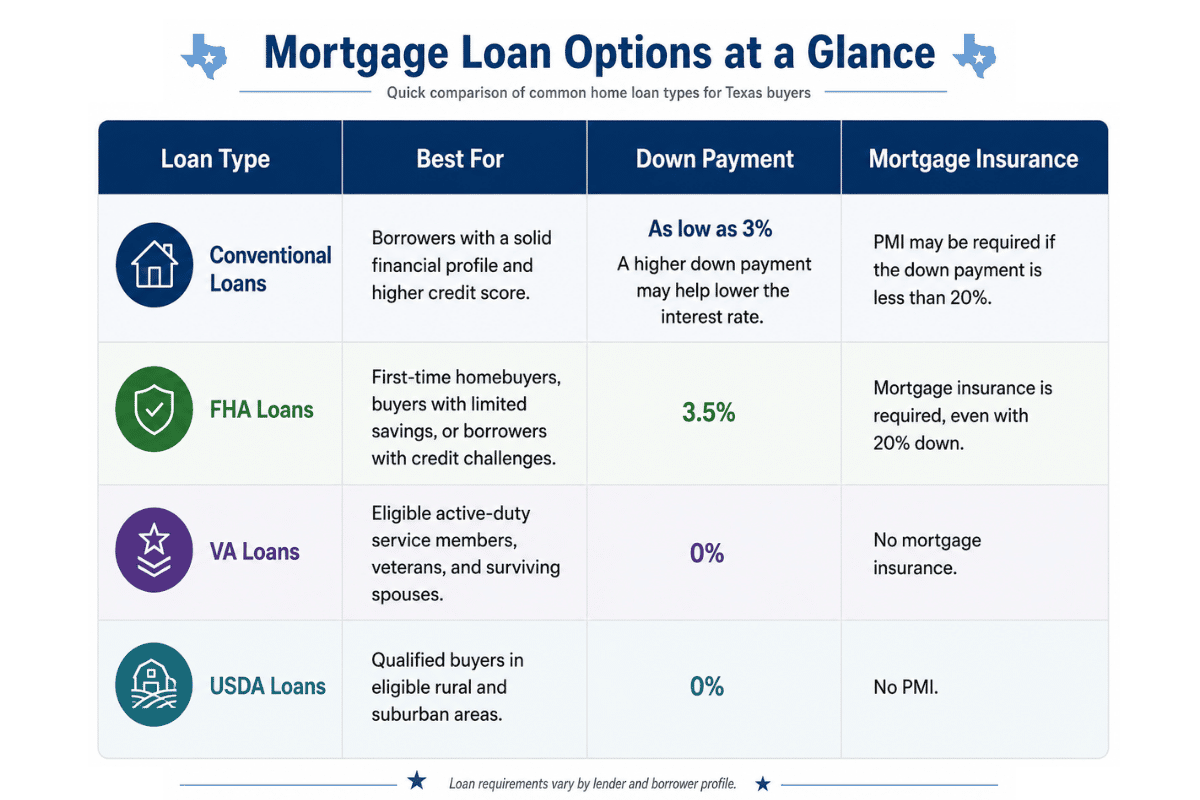
Here are several common loan types and the typical down payment requirement for each:
Mortgages With Low Down Payments
Conventional Loans
- Best for borrowers with a strong financial profile and a high credit score.
- Conventional loans are not federally guaranteed, which means it’s often harder to qualify compared to government-backed loans.
You may put down as little as 3%, but a larger down payment often means a lower rate. Putting down 20% removes private mortgage insurance (PMI).
For example, the minimum down payment for a $350,000 home loan would be $10,500, while a 20% down payment would be $70,000.
FHA Loans
- Great for first-time homebuyers with limited savings or credit challenges.
- You may still qualify even if you don’t meet conventional loan requirements or had a bankruptcy.
Backed by the Federal Housing Administration, FHA loans require a 3.5% down payment. They require mortgage insurance, even if you put 20% down.
For example, the minimum down payment for a $350,000 home loan would be $12,250.
VA Loans
- Designed for active-duty service members, veterans, and eligible surviving spouses and guaranteed by the United States Department of Veterans Affairs.
VA mortgages require zero down payment and offer competitive interest rates. Plus, you don’t need to pay mortgage insurance.
However, there’s a one-time VA funding fee ranging from 0.5% to 3.3%, paid at closing.
USDA Loans
- Also 0% down payment mortgages, USDA loans make homeownership possible for qualified homebuyers in eligible rural and suburban areas.
These loans are backed by the USDA Rural Development Guaranteed Housing Loan Program. They offer competitive rates and don’t require PMI. You must meet the USDA Texas income limits, which vary by county.
In 2023, Bradley and Janna Lanphear moved their family to Texas due to the skyrocketing rental prices in Oregon.
With help from USDA Rural Development, they received a Certificate of Eligibility and later found an affordable home to call their own.
Their story shows how government loans can help qualified buyers, including those who are considering affordable homes in rural areas of Texas.
Down Payment Assistance Programs
The following down payment assistance programs in Texas may help reduce your down payment and sometimes closing costs too if you qualify.
Texas Department of Housing and Community Affairs (TDHCA) Programs
My Choice Texas Home (MCTH) and My First Texas Home (MFTH) offer flexible down payment assistance of 2% to 5% of the loan amount. The assistance may be repayable or forgivable, depending on the loan option.
- MCTH: No first-time homebuyer requirement, making it a good fit for repeat buyers, first-time buyers, and veterans.
- MFTH: Only for first-time homebuyers, qualified veterans, and buyers in targeted areas.
Texas State Affordable Housing Corporation (TSAHC) Programs
Home Sweet Texas and Homes for Texas Heroes offer down payment and closing cost assistance between 2% and 5% of the loan amount with a 30-year fixed first mortgage.
Assistance is available either as a grant or a 0% interest 3-year deferred forgivable second lien. Both programs accept first-time and repeat buyers, and they’re available with conventional, FHA, VA, and USDA loans.
Pro Tip: Review your loan options and repayment terms with an experienced loan officer who’s familiar with different mortgages and down payment assistance programs in Texas. A mortgage expert will help you understand each loan’s eligibility requirements and other rules for a smoother application process.
Factors Affecting Your Down Payment
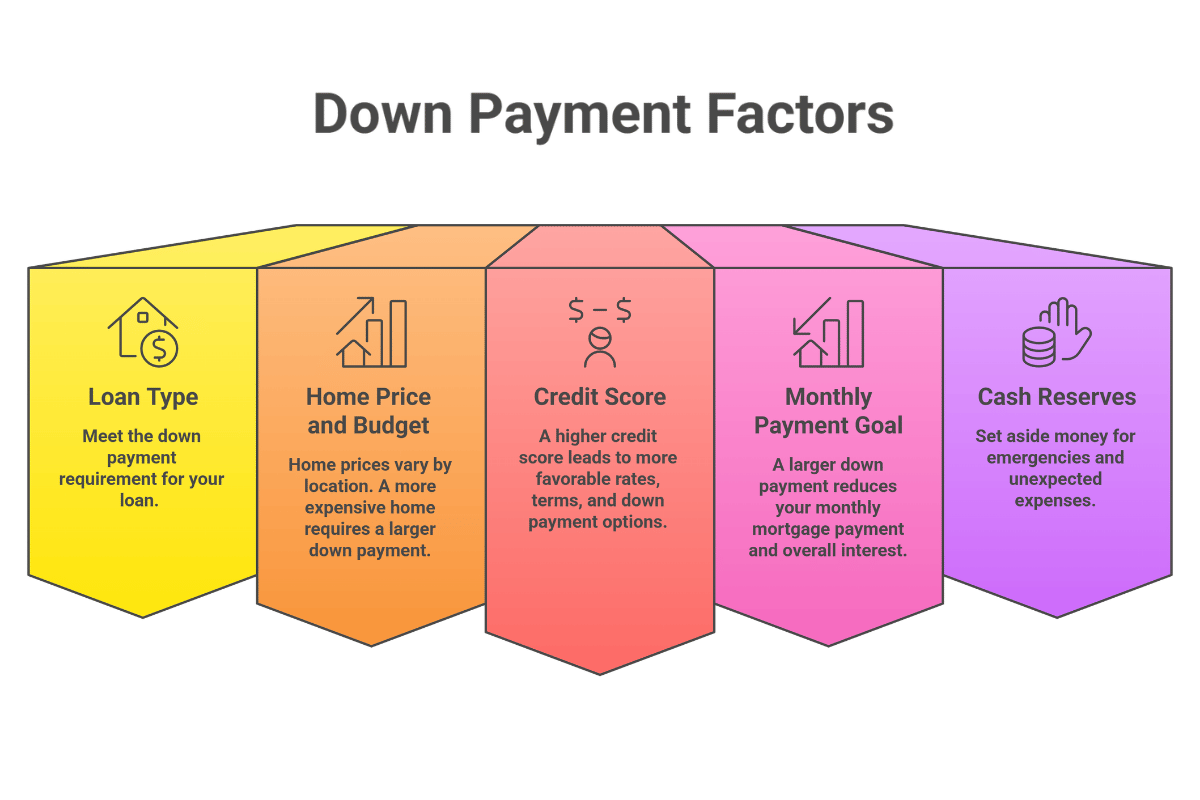
So, how much is the ideal down payment for a house in Texas?
The quick answer: It varies widely, depending on your personal circumstances, financial goals, and market conditions.
Here are key factors to consider:
- Loan Type: You must meet the down payment requirement for the loan you’re getting. Consider government-backed loans if you want a zero-down-payment option.
- Home Price and Budget: Home prices vary by location, so be sure to find out the price range of the property you want to buy. If you’re aiming to buy a more expensive home, you’ll have to pay a larger down payment even if the percentage stays the same. For example, putting down 3% for a $250,000 home would be $7,500. For a $400,000 home, your down payment would be $12,000.
- Credit Score: You’ll get more favorable rates, terms, and down payment options with a higher score.
- Monthly Payment Goal: A larger down payment can significantly reduce your monthly mortgage payment and the overall interest you’ll pay over the life of the loan.
- Cash Reserves: Avoid depleting your savings. It’s best to set aside money as a financial cushion for emergencies and unexpected expenses.
How to Determine the Ideal Down Payment for Your Home Purchase
Follow these quick steps to estimate the amount you can spend upfront when buying a home:
Step 1: Calculate your total available funds based on your savings and investment statements.
Step 2: Subtract the amount you want to keep for other financial goals, home repairs, furniture, or moving costs.
Step 3: Subtract an extra amount for emergencies, preferably enough to cover three to six months of expenses.
And that’s it. The remaining balance is your available cash for your down payment and other homebuying costs. Closing costs are usually between 2% and 5% of the home purchase price.
Should You Make a Large Down Payment?
You don’t need to put down 20%, although a substantial down payment offers significant benefits:
- Smaller loan balance and more manageable monthly payment: You'll start with more home equity when you purchase your home, which helps when you need to refinance or sell later.
- Lower interest rates: A larger down payment reduces the lender’s risk, helping you qualify for better rates.
- No PMI: A 20% down payment removes PMI when you’re getting a conventional loan.
Pro Tip: Compare whether it makes more sense to spend months or years saving a larger amount or buy sooner with a smaller down payment. Also, if you plan to stay in the house for only a short time, it may be better to put down a smaller amount.
Start Saving and Get Expert Guidance
Ultimately, a reasonable down payment is the amount you feel comfortable paying without draining your savings or raising your monthly mortgage payment too much.
Take time to save for your goal. Be realistic when determining the right amount for your down payment.
If you need help comparing your loan options and planning the right down payment, our experienced loan officers at Texas United Mortgage offer dependable, personalized assistance.
Contact us today to get pre-approved!
Next, learn more about Texas home loans with no down payment with our extensive guide.









Comments